Mammals
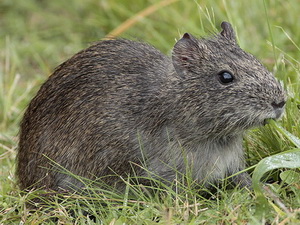
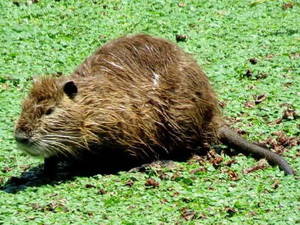
Mammals are a class of warm-blooded vertebrates. They possess hair and mammary glands, which produce milk to feed the young. They are viviparous, that is, the embryo develops inside the body of the mother. The degree of maturity at birth differentiates three subclasses (monotremes, placentals and marsupials). Placentals are nourished in the mother's uterus through the placenta. Young are born live and do not take long to fend for themselves. Though most placentals are difficult to see during the day, coypus and guinea pigs may be the exceptions. Marsupials, instead, have no true placenta, therefore the embryo has to obtain nutrients somehow. As they leave the uterus they present an uneven development. Hind legs and facial parts are more developed than other parts of the body. By using the hind legs they will crawl to the nipple where they will remain attached to until they complete development.
Marsupials
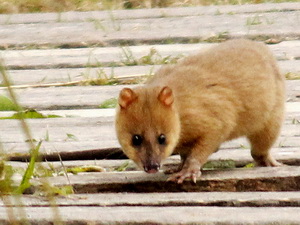
Lutrine opossum
Lutreolina crassicaudata
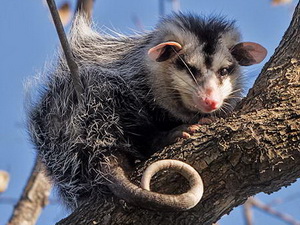
White-eared opossum
Didelphis albiventris
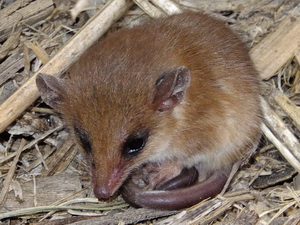
Agile gracile opossum
Cryptonanus chacoensis
Placentals
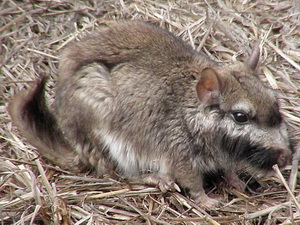
Plains vizcacha
Lagostomus maximus
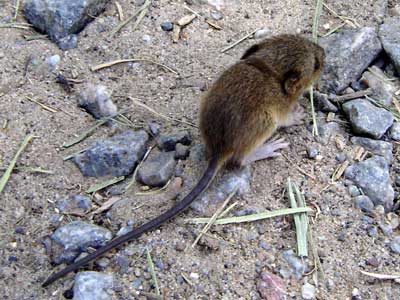
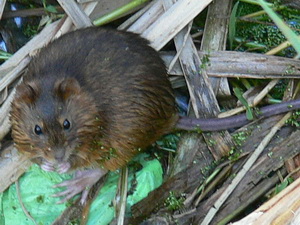
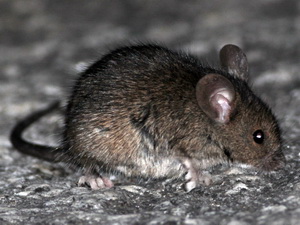
Yellow pygmy rice rat
Oligoryzomys flavescens
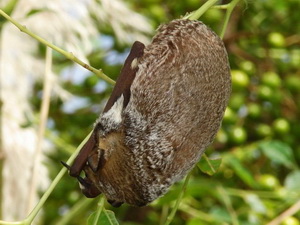
Hoary bat
Lasiurus cinereus
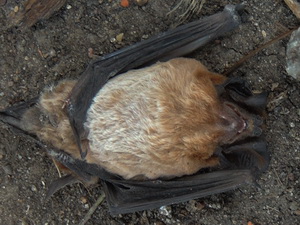
Peters's mastiff bat
Eumops bonariensis
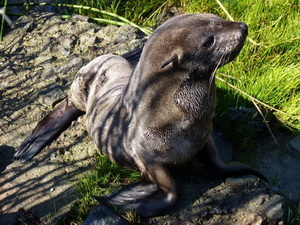
South American fur seal
Arctophoca australis
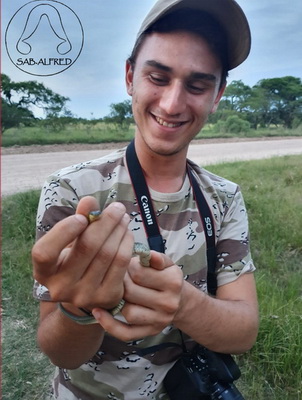
Alfredo Sabaliauskas: collaborates in the amphibian and reptile sections
Hi! I am Alfredo Sabaliauskas. I am studying biology, I like wildlife photograph and love animals, in particular reptiles and amphibians. My instagram account is @sab.alfred. I have been a member of the COARECS for 4 years now and two years ago I began volutneering at the herpelogic division of the Museo Argentino de Ciencias Naturales. I intend to raise consciousness about reptiles and amphibinas of our country, not very well-famed part of the wild life but very interesting in fact. If in need of reptile or amphibian identification, send a mail to [email protected]
Amphibians
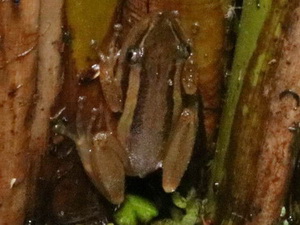
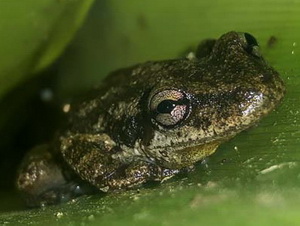
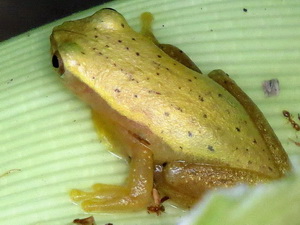
Amphibians are a group of cold-blooded vertebrates. They go through metamorphosis after hatching. They change from gill-breathing (completely water-depending) like fish to lung-breathing (living mainly on land). They hibernate during winter.They are considered ecological indicators. Their presence indicates lack of pollutants in the environment.There is only one order registered here - Anura (toads and frogs).
Main differences between frogs and toads for identification.
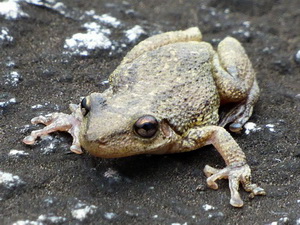
Frogs have smooth skin and longer hind legs adapted for leaping.
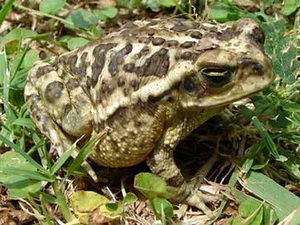
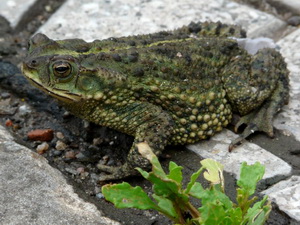
Toads are bulky and have warty skin. Their hind legs are short (for walking not for leaping)
Anura (frogs and toads)
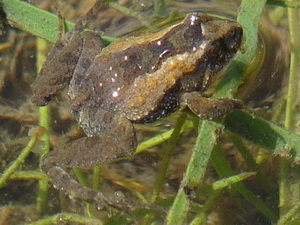
Hensel's swamp frog
Pseudopaludicola falcipes
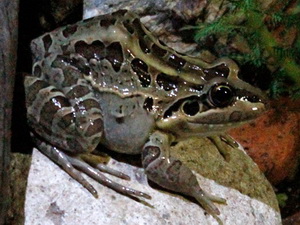
Creole frog
Leptodactylus latrans
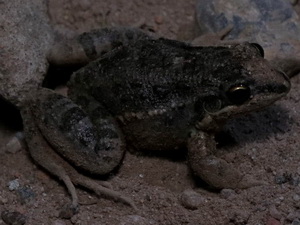
Oven frog
Leptodactylus latinasus
Common Toad
Rhinella arenarum
Bella Vista Toad
Rhinella fernandezae
Lesser swimming frog
Pseudis minutus
Snoaring frog
Scinax granulatus
Striped snouted tree frog
Scinax squalirostris
Dwarf snouted tree frog
Scinax berthae
Dwarf tree frog
Dendropsophus sp.
Turtles
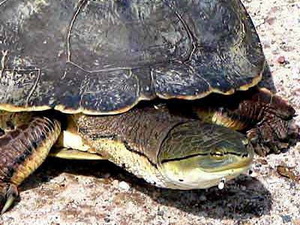
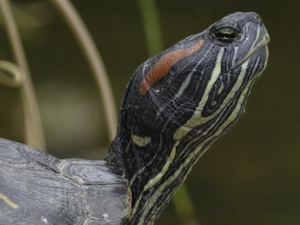
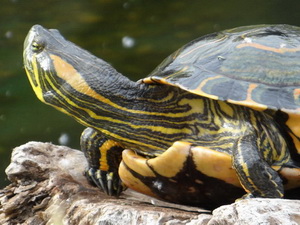
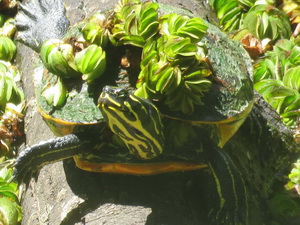
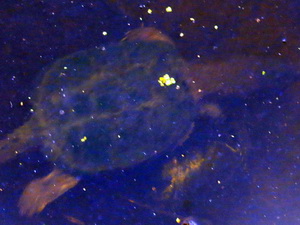
Turtles belong into the order of reptiles. They are characterised by a protective shield which allows only head, legs and tail to be seen through two openings, one at the front and the other at the back. In case of threat these parts may also disappear in the inside. The shield consists of two shells -carapace and plastron, upper lower parts respectively- joined together at the sides by bony structures.Turtles are classified according to the way they withdraw their head into their shells. Side-necked turtles or Pleurodira fold their long neck laterally between the carapace and plastron leaving the head and neck partially exposed. They are only found in the Southern Hemisphere. Hidden-necked turtles or Cryptodira pull their heads back into the shell with vertebrae adopting an S form in the inside. Both groups are represented at Costanera.The four registered species (three are native and one is exotic) live in the ponds. Webbed feet, limbs rather flattened and a streamlined carapace are the adaptations to aquatic life. Though they spend most of their time in water they lay eggs on land. Females dig a hole where eggs are buried and left unattended.
Snake-necked Turtle
Hydromedusa tectifera
Side-necked Turtle
Phrynops hilarii
Red-eared Turtle
Trachemys scripta elegans
Painted Turtle
Trachemys dorbignyi
Florida red-bellied turtle
Pseudemys nelsoni
Common snapping turtle
Chelydra serpentina
Scaled reptiles
They are so called because their body is covered with horny scales. They are divided in three suborders quite different in appearance: lizards, snakes and worm lizards. All of them are represented at Costanera.
Lizards
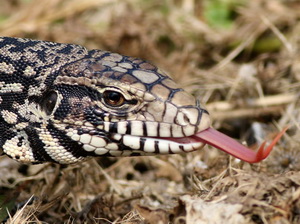
Lizards have four short legs adapted to locomotion. The long tail can be shed and regenerated. The mandibles are not mobile. On the contrary, the eyelids are.
Black-and-white Tegu Lizard
Salvator merianae
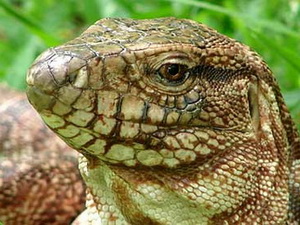
Red Tegu Lizard
Salvator rufescens
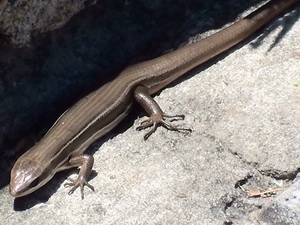
Mabuya
Aspronema dorsivittatum
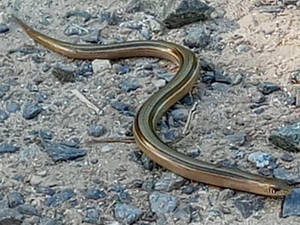
Glass snake
Ophiodes intermedius
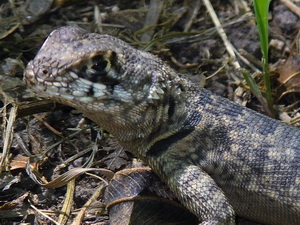
Etheridge's Lava Lizard
Tropidurus etheridgei
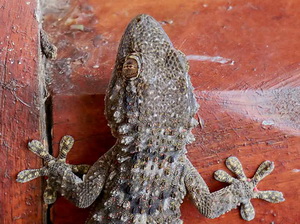
Common Wall Gecko
Tarentola mauritanica
Snakes
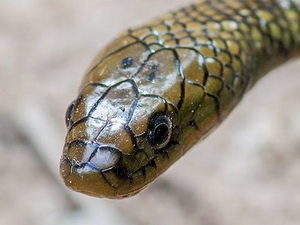
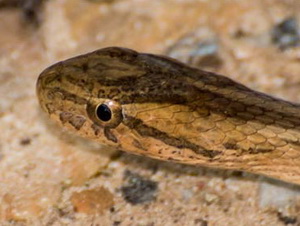
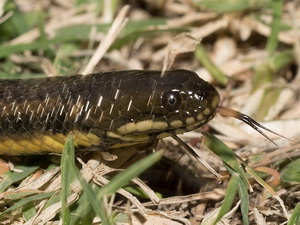
Snakes have no limbs, so they crawl. They have elongated body and tail. Mandibles are joined by ligaments. This gives great bite mobility allowing the passage of big pieces through them. They have no mobile eyelids; only a fixed and transparent eyelid covers the eye. Snakes may be venomous or non-venomous. Some traits may help us to tell them apart. Unfortunately they are not always foolproof. So it is wise to keep away from them in case of doubt.a) Non-venomous snakes have big scales covering their heads. Venemous snakes have small scales.b) Non-venomous snakes have big eyes and round pupils. Venomous snakes have smaller eyes and elliptical pupils like the cat’s eye.c) Non-venomous snakes have rounded heads. Venomous snakes have spear-like heads.
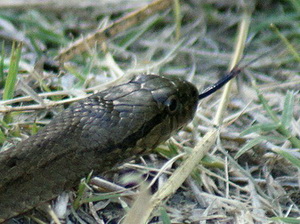
To identify a snake a photo of the head is crucial since in a great number of species the diagnostic characters are found there. That is, spots on the supra and infralabial scales, eye size, protuberances on the snout or depression on the neckThe number of the scales on the head is used to tell similar species apart and sometimes it is very difficult to rely on photographs. Besides a photo of the neck, the upperpart is also useful for pattern identification. The patterns are normally uniform all along the upperparts, so a photo of half the body is enough. The whole body also works.
So, in summary to identify a snake:
1 photo of the head, better if it includes lateral and/or dorsal views
2 photo of the upperparts or the whole body to observe the pattern
3 Habits of the individual, where it was, near a body of water, in a tree, etc
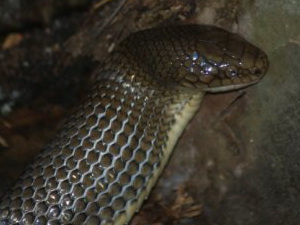
Brown mussurana
Paraphimophis rustica
Golden liophis
Erythrolamprus semiaureus
Keeled sepia snake
Thamnodynastes hypoconia
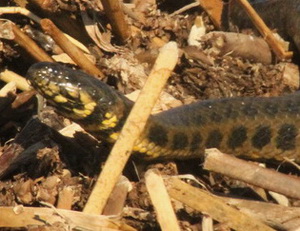
Tree coastal house snake
Thamnodynastes strigatus
Dipsadid snake
Helicops infrataeniatus
Dipsadid snake
Helicops leopardinus
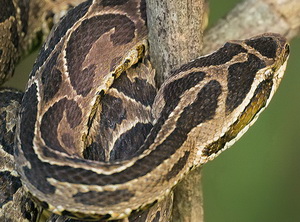
Urutu Pit Viper
Bothrops alternatus
Worm Lizards
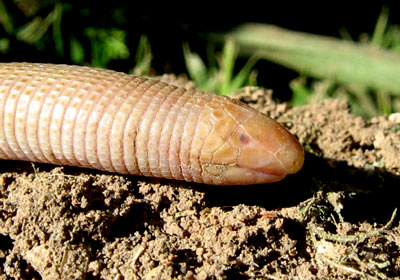
Worm lizards are adapted to underground life. They have an elongated cylinder-like body and are limbless, but for one species. Scales arrange in rings. So, worm lizards move in an accordion-like way and can do it forwards or in reverse indistinctly. It has atrophied eyes. Tail and head are quite similar in form and almost indistinguishable.
Worm Lizard
Amphisbaena sp.
Guillermo Spajic collaborates in the fish section
Passionate about fish, keen nature observer and sport fisherman. Founding partner and member of the Directive Committee of AAPS (Argentine Assoication of Bait and Fly Fishing). This entity has the primary goal of preserving fish species and responsible fishing. Member of COA Carancho (Club de Observadores de Aves de Palermo - Birdwatchers' Club). Former teacher at the Fishing School for Kids of the Club de Pescadores de Buenos Aires. I run "Pesca en Streaming", a radio program oriented to spread responsible fishing and issues related to nature and conservation.
Fish
Fish are aquatic vertebrate animals which are characterized by having most of them scales, fins and gills, which allow them to get the oxigen from water. They are ectothermic, that is cold-blooded, their temperature varies according to ambient temperature.
Marbled swamp eel
Synbranchus marmoratus
Livebearer
Cnesterodon decemmaculatus
Catfishes
Flia Loricariidae
Long-whiskered Catfish
Pimelodus maculatus
Long-whiskered Catfish
Parapimelodus valenciennis
Granulated Catfish
Pterodas granulosus
Speckled Piranha
Serrasalmus spilopleura
Shad
Prochilodus lineatus
Pike characin
Oligosarcus jenynsii