Reserva Ecológica Costanera Sur

Sitio realizado por aficionados a la observación de aves desde 10 de enero 2006

Browsing Posts in Habits

Cinnamon Warbling-Finch
Poospiza ornata
Monterita canela/Cinnamon Warbling-Finch© J. Simón Tagtachian
Barn Swallow
Hirundo rustica
Golondrina tijerita/Barn SwallowAn espectacular head turn to catch an insect on the wing
© J. Simón Tagtachian
Blue-and-white Swallow
Pygochelidon cyanoleuca
Golondrina barranquera/Blue-and-white Swallow© J. Simón Tagtachian
White-winged Becard
Pachyramphus polychopterus
Anambé comúnN/White-winged BecardN
© J. Simón Tagtachian
Anambé comúnH/White-winged BecardF© J. Simón Tagtachian Anambé comúnH/White-winged BecardF© J. Simón Tagtachian
Anambé comúnR/White-winged BecardBNest. Mum with an insect which is delivered to the chick.
© J. Simón Tagtachian
Calico Flower
Aristolochia elegans
Mil hombres/Calico flower© C. y T. Di Mauro
Brown-chested Martin
Progne tapera
Golondrina parda/Brown-chested Martin© C. y T. Di Mauro Golondrina parda/Brown-chested Martin© C. y T. Di Mauro
Golondrina parda/Brown-chested MartinAgain they begin their trip back to the north of South America and as usual the antenna is their meeting point.
© C. y T. Di Mauro
Nanday Parakeet
Nandayus nenday
ÑandayB/Nanday ParakeetFA big flock of almost 200 individuals flying from Viamonte Access to Brasil Access. Impossible to get a picture of all of them.
© C. y T. Di Mauro
Tropical Kingbird
Tyrannus melancholicus
Surirí real/Tropical Kingbird© C. y T. Di Mauro
Saffron Finch
Sicalis flaveola
Jilguero doradoMH/Saffron YellowfinchMFMale and female
© C. y T. Di Mauro
White-lined Tanager
Tachyphonus rufus
Frutero negroM/White-lined TanagerMMale
© C. y T. Di Mauro
White-lined Tanager
Tachyphonus rufus
Frutero negroH/White-lined TanagerFFemale
© C. y T. Di Mauro
Two images of the Swainson’s Flycatcher
Myiarchus swainsoni
Burlisto pico canela/Swainson's Flycatcher© Pablo Mosto

Burlisto pico canela/Swainson's Flycatcher© Pablo Mosto
Streaked Flycatcher
Myiodinastes maculates
Benteveo rayado/Streaked Flycatcher© Pablo Mosto
Changes in “The Cast”
The Cast has been updated with the changes published by the SACC (South American Classification Committee) in the last version dating December 7th, 2012.

I draw the attention to some of them. Psittacids (parrots) have ousted Picids (woodpeckers) from the last position within Non Passeriformes. Many embericids have joined the Thraupids to the extent that there are only two bird species left (Rufous-collared Sparrow and Yellow-striped Brush-Finch). A new family Tityridae has been created.
I want to make clear that Saltators still remain within the Family Cardinalidae though they have been removed from it. SACC has provisionally placed them within the group Insertae Sedis (of uncertain placement) till their new relocation is defined.

New bird species: Mottle-cheeked Tyrannulet
Phylloscartes ventralis
Mosqueta común/Mottle-cheeked Tyrannulet© J. Simón Tagtachian
See more photos
Vermilion Flycatcher
Pyrocephalus rubinus
ChurrincheJ/Vermilion FlycatcherJJuvenile
© J. Simón Tagtachian
Bare-faced Ibis
Phimosus infuscatus
Cuervillo cara pelada/Bare-faced Ibis© J. Simón Tagtachian
Chimango Caracara
Milvago chimango
Chimango/Chimango Caracara© J. Simón Tagtachian
Brazilian guinea pig
Cavia aperea
Cuis/Brazilian guinea pig© J. Simón Tagtachian
Painted Turtle
Trachemys scripta dorbignyi
Tortuga pintada/Painted Turtle© J. Simón Tagtachian
Nanday Parakeet
Nandayus nenday
NandayJ/Nanday ParakeetJJuvenile
© J. Simón Tagtachian
Glittering-bellied Emerald
Chlorostilbon lucidus
Picaflor comúnJ/Glittering-bellied EmeraldJJuvenile
© J. Simón Tagtachian
Sayaca Tanager
Thraupis sayaca
Celestino/Sayaca Tanager© J. Simón Tagtachian
Roadside Hawk
Rupornis magnirostris
Taguató común/Roadside Hawk© J. Simón Tagtachian
Picui Ground-Dove
Columbina picui
Torcacita común/Picui Ground-Dove© J. Simón Tagtachian
White-winged Becard
Pachyramphus polychopterus
Anambé comúnH/White-winged BecardFFemale
© J. Simón Tagtachian
Rufous Hornero
Furnarius rufus
HorneroD/Rufous HorneroD© J. Simón Tagtachian
Rufous Hornero
Furnarius rufus
HorneroD/Rufous HorneroD© J. Simón Tagtachian
White-tipped Plantcutter
Phytotoma rutila
CortarramasH/White-tipped PlantcutterFAnd now she came
© Claudia y Diego Bastías
Gray-throated Warbling-Finch
Poospiza cabanisi
Monterita litoraleñaJ/Gray-throated Warbling-FinchJJuvenile
© Pablo Serur
Hooded Siskin
Sporagra magellanica
Cabecitanegra comúnD/Hooded SiskinDMale
© Pablo Serur
Tropical Kingbird
Tyrannus melancholicus
Suirirí real/Tropical Kingbird© Pablo Serur
Maguari Stork
Ciconia maguari
Cigüeña americanaB/Maguari StorkF© Francisco González Táboas

On Saturday, 16th a flock of storks was observed from inside the reserve by Francisco who estimated ” about 50 o 60 individuals flying in circles above the Covimet area or far south”. From the garden of “Ernesto de la Cárcova” Museum, outside the reserve, María Claudia, also captured images of a flock and adds that “they were heading north from Costanera Sur”. Photos were taken with some time apart. They must be different flocks.
There are too many individuals with black wings. They are still immature birds.

Cigüeña americanaB/Maguari StorkF© María Claudia Kleid

Ultramarine Grosbeak
Cyanocompsa brissonii
Reinamora grandeJ/Ultramarine GrosbeakJJuvenile
© Raj Phukan
White-tipped Plantcutter
Phytotoma rutila
CortarramasM/White-tipped PlantcutterMAnother winter visitor, in this case a male Plantcutter, which has just arrived at Costanera
© Pablo Mosto
White-winged Becard
Pachyramphus polychopterus
Anambé comúnM/White-winged BecardM© Pablo Mosto

The White-winged Becard has never fit to the letter within a family. First it was included in the Cotingidae Family. Then it was moved to the Tyrannid Family since the morphology of the syrinx (vocal organ) was much more similar to that of tyrannids’. Even then this did not satisfy taxonomists. Recent morphological and genetic studies have shown a common thread for this and almost other 30 bird species which were in the same situation. All of them have been grouped in a new family: Tityridae.
Only eight of the 30 bird species are represented in Argentina. and only three of them have photographic record on this site. They are:
White-winged Becard Pachyramphus polychopterus frequent summer visitor and breeder, illustrated in the photo by a male
Green-backed Becard Pachyramphus viridis with the only record of a female in 2010 and
White-naped Xenopsaris Xenopsaris albinucha with a breeding record in 2000.
CR

Harris's Hawk
Parabuteo unicinctus
Gavilán mixto/Harris's Hawk© Pablo Mosto
White-crested Tyrannulet
Serpophaga subcristata
Piojito común/White-crested Tyrannulet© Pablo Mosto
Double-collared Seedeater
Sporophila caerulescens

Feeding

A fledgeling exhibiting the typical food solicitation display to call its mother’s attention. It is attentively following its mother’s movements, ready to open its mouth and increasingly flapping its wings as the adult gets near. The delivered food is seeds, which must certainly be Guinea grass, which is their favourite grass.
© Pablo Serur

Warbling Doradito
Pseudocolopteryx flaviventris
Doradito común/Warbling Doradito© Pablo Serur
Snail Kite
Rostrhamus sociabilis
CaracoleroJ/Snail KiteJImmature
© Pablo Serur
White-banded Mockingbird
Mimus triurus
Calandria real/White-banded MockingbirdThe first winter visitor to arrive
© Claudia y Diego Bastías
Children and grown-ups: Everybody is having a bath
baño/bathing(Top) Male Masked Yellowthroat Geothlypis aequinoctialis and Rufous-collared Sparrow Zonotrichia capensis, (Middle) Rufous-collared Sparrow Zonotrichia capensis and Double-collared Seedeater Sporophila caerulescens, and (Bottom) Double-collared Seedeater Sporophila caerulescens and Juvenile Rufous-collared Sparrow Zonotrichia capensis
© Milano-Muszkats
Streaked Flycatcher
Myiodinastes maculatus
Benteveo rayadoJ DF 12-12 Benteveo rayadoJ DF 12-12
Luckily there was a breeding record of Streaked Flycatcher.

Dolores tells us that “I remembered that I had seen a juvenile in the Middle Path in December. These are the photos I took on 30th of December. I did not send it since I did not consider it of any interest but that of staying long finding the best position to take a shot of the juvenile when it was bed. But I only managed to photograph the juvenile with the fruit already in the mouth and the adult is not seen. ”
© Dolores Fernández

Screaming Cowbird-Bay-winged Cowbird
Molothrus rufoaxillaris – Agelaioides badius
TordosP/CowbirdsP© Milano-Muszkats
A juvenile of Screaming Cowbird on top and a Bay-winged Cowbird, below. The Screaming Cowbird parasitizes almost exclusively the Bay-winged Cowbird. The juveniles of these two species are quite alike till the Screaming Cowbird acquires black spots.

Tordo músicoR/Bay-winged CowbirdR© Carlos Gonzalez Ledo
The Bay-winged Cowbird, instead, practically changes into the adult plumage
Two summer visitors are about to leave
Anambé común/White-winged BecardWhite-winged Becard
Pachyramphus polychopterus
© Amelia Besana
Benteveo rayado/Streaked FlycatcherStreaked Flycatcher
Myiodinastes maculatus
© Carlos Gonzalez Ledo
These two species visit us for the summer. There are records which show they breed here. Juvenile White-winged Becard were photographed this year, but none were taken to the Streaked Flycatcher.
Juveniles
Tordo pico cortoJ/Screaming CowbirdJScreaming Cowbird
Molothrus rufoaxillaris
© Milano-Muszkats
Sietevestidos comúnJ/Black-and-rufous Warbling-FinchJBlack-and-rufous Warbling-Finch
Poospiza nigrorufa
© Milano-Muszkats
Cardenal comúnJ/Red-crested CardinalJRed-crested Cardinal
Paroaria coronata
The crest has started to change colour
© Carlos Gonzalez Ledo
CardenillaJ/Yellow-billed CardinalJYellow-billed Cardinal
Paroaria capitata
First red feathers
© Carlos Gonzalez Ledo
Hooded Siskin
Carduelis magellanica
Cabecitanegra comúnH/Hooded SiskinFFemale
© Carlos Gonzalez Ledo
Bay-winged Cowbird
Agelaioides badius
Tordo músico/Bay-winged CowbirdCowbirds look interested in the contents of the rucksack
© Carlos Gonzalez Ledo
Consequences of March 2nd Storm
Después de la tormenta/After the stormWe can see how the wind broke thisTipuana tipu‘s branch which is at the beginning of the Viamonte Canal and it was not the only one.
© Carlos Gonzalez Ledo
VN:F [1.9.22_1171]
Rating: 5.5/10 (2 votes cast)
VN:F [1.9.22_1171]
Rating: 0 (from 2 votes)
Wood Storki
Mycteria americana
Tuyuyú//South American Wood StorkI saw this group of 7 individuals making a big turn above us
© J. Simón Tagtachian
Roadside Hawk
Buteo magnirostris
Taguató/Roadside Hawk© J. Simón Tagtachian
Hooded Siskin
Carduelis magellanica
Cabecitanegra/Hooded SiskinA small flock having a bath accompanied by a Creamy-bellied Thrush
© J. Simón Tagtachian
Fork-tailed Flycatcher
Tyrannus savana
Tijereta/Fork-tailed FlycatcherOne of the several juveniles that migrated on the 20th
© J. Simón Tagtachian
Yellow-winged Blackbird
Agelasticus thilius
Varillero ala amarilla/Yellow-winged Blackbird© J. Simón Tagtachian
Masked Yellowthroat
Geothlypis aequinoctialis
Arañero cara negraH/Masked YellowthroatFFemale
© J. Simón Tagtachian
Solitary Cacique
Cacicus solitarius
Boyero negro/Solitary Cacique© Oscar Melo
Rufescent Tiger-Heron
Tigrisoma lineatum
Hocó colorado/Rufescent Tiger-Heron © Roberto Ares
Green-winged Saltator
Saltator similis
Pepitero verdoso/Green-winged Saltator© Mariano Ordoñez
Fawn-breasted Tanager
Pipraeidea melanonota
Saíra de antifaz/Fawn-breasted TanagerOff-season sighting. This tanager visits us in winter
© Pablo Mosto
Grayish Saltator
Saltator coerulescens
Pepitero gris/Grayish Saltator© Pablo Mosto
Some more insects
Insectos/InsectsGo to Invertebrates
For-tailed Flycatcher
Tyrannus savana

Video © Roberto Ares
Migración
(See in full screen. First right icon on tool bar)

We were reaching the cement pitch when a first group of six Fork-tailed Flycatchers, which I could not see, flew past over our heads. They were heading north. A bit later a front of several flycatchers emerged out of the top of the trees which flank the path. Flying low they dodged and mixed with pigeons, martins and other birds that are normally there. In a more or less disorderly way they progressed in a northerly direction and we lost sight of them. And a new wave appeared and so went on the bouts with dozens of flycatchers each. We were amazed at the number of individuals thay flew past. It was a feast. Some sat for a while on a branch and resumed flight with the same group or with the following one. Juvenile and female tails (18cm) outnumbered male tails (34 cm), a considerable difference in size. Several males had one of their rectrices broken. One of them was filmed during a stop.

Such a flow of individuals could be nothing else but migration. In their migration route to the south the groups which spread out from the principal trunk aggregate again on their return trip gathering at roosting sites. Now in bigger quantities since juveniles born here also join the group. Is Costanera one of these favoured sites? For my part, this is the first time I have seen the migration of Fork-tailed Flycatchers. Of course, this is so short a time window that one must be at the right time and place to witness it.

There are four subspecies of Fork-tailed Flycatchers having different migratory behaviour. The one that migrates to Argentina (Tyrannus savana savana) comes from the northern extreme of South America and is highly migratory. There is a transient species and the other two are resident. Tyrannus savana savana arrives in September-October to spend summer. Here it breeds and returns in February-March to winter in the north. Last year’s first photographic record was in October. Today, the 20th of February we saw them leave.

Text: Cora Rimoldi

Campo Troupial
Icterus jamacaii
Turpial/Campo TroupialThe “cousins”…
© Carlos Gonzalez Ledo
Orange-backed Troupial
Icterus croconotus
Matico/Orange-backed Troupialare still together
© Carlos Gonzalez Ledo
Red-eyed Vireo
Vireo olivaceous
Chiví común/Red-eyed Vireo© Carlos Gonzalez Ledo
Narrow-billed Woodcreeper
Lepidocolaptes angustirostris
Chinchero chico/Narrow-billed WoodcreeperParticular position of the legs to grasp onto this smooth light pole.
© Carlos Gonzalez Ledo
Cigüeña americana
Ciconia maguari
Cigüeña americana/Maguari StorkIt flew around the reserve trying to land. But finally it did not.
© Carlos Gonzalez Ledo
Monk Parakeet
Myiopsitta monachus
Cotorra/Monk ParakeetEating the flower of Silk Floss Tree Ceiba speciosa
© Carlos Gonzalez Ledo
Glittering-bellied Emerald in trouble
Picaflor común/Glitterning-bellied Emerald© Javier Ubiría Picaflor común/Glitterning-bellied Emerald© Javier Ubiría
Norberto heard the desperate screamings of the juvenile Emerald. It was caught in the resistent spider of the nephila (one of the most resistent among the arachnids). The web was big. The hummingbird very small and light. It could not have freed by its own means.
When we detected the presence of the spider (unluckily out of frame) 20 cm away, Norberto rushed to rescue the hummingbird. His prompt action lasted a few seconds. He swiped it off and released it. The Emerald was exhausted and shocked. It stayed in his hand till it recovered and flew off.

The “bad” spider was about to kill the “good” hummingbird. I did not intend to interfere in a natural process. In a phenomenon which is apparently cruel and merciless. The observer must watch without interfering. Again the eternal game between life and death. The prey’s death which means the predator’s life.
The web got destroyed during the realease of the Emerald and the spider was dragged to the ground.
As we all know, there are species which are ill-famed: spiders, snakes, owls, sharks and the list goes on.

Javier Ubiría

New bird species: Dark-throated Seedeater
Sporophila ruficollis
Capuchino garganta café/Dark-throated SeedeaterJuvenile photographed in october 2011
10-2011© Pablo Mosto
Scissor-tailed Nightjar
Hydropsalis torquata
Atajacaminos tijeraH/Scissor-tailed NightjarFPhoto taken in 2011. But it is worth watching the details of this female Scissor-tailed Nightjar so exposed in broad daylight. The Nightjar becomes active at dusk so poor light prevents us from having a good look at it.
2-2011 © Rosana Ursino
Chotoy Spinetail
Schoeniophylax phryganophilus
Chotoy/Chotoy Spinetail© Pablo Mosto
The Chotoy Spinetail appeared from time to time at Costanera. Last October it popped up and stayed to breed. During that time it was difficult to capture images since it moved surreptitiously so as not to be discovered. Here, instead, we can fully appreciate this relative of the Rufous Hornero. Long tail with two spines. Rufous crown and shoulders. Yellow chin and black throat flanked white.
CR
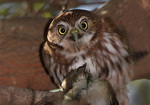
Ferruginous Pygmy-Owl
Glaucidium brasilianum
Caburé chico/Ferruginous Pygmy-Owl© Pablo Mosto Caburé chico/Ferruginous Pygmy-Owl© Pablo Mosto
These two photos were taken a bit before the video. Pablo told us about the pygmy-owl. The prey is a juvenile of Small Elaenia
Caburé chico
Glaucidium brasilianum


Aves non gratae
Among the bird species present at Costanera the Southern Caracara and the Ferruginous Pygmy-Owl are considered unwanted because they prey on birds, among other things. The birds know the risk they run when either of them are close. So they take courses of action that differ from one another.

The Southern Caracara is stalked either solitarily or in pairs by the Chalk-browed Mockingbird (25 cm) and the Fork-tailed Flycatcher (38 cm) among other birds. They mob on the Caracara till it is driven away. It is chased and even pecked at on the wing. It seems funny to see how the big Caracara is driven away by a much smaller bird.
Unlike the Caracara, the Ferruginous Pygmy-Owl is small in size (15 cm) and is harrassed by several bird species. The owl’s attitude is “I won´t move”. It stays undaunted in its place. There is a disconcerted flight around it screaming insistently. A sort of public protest so noisy that it is a useful signal for us to spot the owl. Otherwise, this small and cryptic bird is easily skipped in a tree.

In this case there was a Red-eyed Vireo, a male Masked Yellowthroat, a Small-billed Elaenia, a Streaked Flycatcher (not appearing in the video), three Masked Gnatcatchers and several Emeralds (definitely some females). All of them sounded very altered. The feathered ball which appears under the branch is the juvenile Small-billed Elaenia of the above photos. It held it tightly with the claws and stood motionless only moving its head to keep visual contact with the birds flying by. None of them attacked the owl. They only put pressure by flying very close to it. At a point it moved to another branch and stood there for a while till it left.

Video © Roberto Ares – Texto Cora Rimoldi

Blue-billed Black-Tyrant
Knipolegus cyanirostris
Viudita pico celesteH/Blue-billed Black-TyrantFFemale
© Pablo Serur
Viudita pico celesteH/Blue-billed Black-TyrantFFemale
© Pablo Serur
South American Snipe
Gallinago paraguaie
Becasina común/South AmericanCommon Snipe© J. Simón Tagtachian
Ringed Teal
Callonetta leucophrys
Pato de collar/Ringed TealPair
© J. Simón Tagtachian
Ringed Teal
Callonetta leucophrys
Pato de collar/Ringed TealIn flight circular white patch is seen
© J. Simón Tagtachian
Brazilian Teal
Amazonetta brasiliensis
Pato cutirí/Brazilian TealIn flight white triangular patch and blue speculum are seen
© J. Simón Tagtachian
Glittering-bellied Emerald and Gilded Sapphire
Chlorostilbon aureoventris – Hylocharis chrysura

If in flower is the silk floss tree hummingbirds around you’ll see
The Silk Floss tree Ceiba speciosa at the Viamonte Access is loaded with flowers. Joy to our eyes and a nutritious food source for the hummingbirds. There were a Gilded Sapphire (bronze colour) and a female Glittering-bellied Emerald (with grayish underparts), some time later a male showed up, too. The Gilded Sapphire defended from the competitors what it considered its tree. As the Sapphire identified an intruder it pounced on it to drive it away. The intruder reacted by escaping and the Sapphire escorted it to make sure it left the grounds. But success was temporary since the Emerald was back in no time and the sequence was repeated. When the male Glittering-bellied Emerald showed up things got worse for the Sapphire, now there were two intruders to be expelled from its territory. The movement of hummingbirds is so fast that only these scenes could be rescued. Among them, two chases

© Roberto Ares – Text: Cora Rimoldi

February 2nd – World Wetlands Day
This day in 1971 in Ramsar, Iran, a treaty on wetlands was signed. It provides a framework for the conservation and sustainable use of their resources.
Wetlands are defined as extensions where water is a crucial element and its regime (permanent or temporal water, tides, etc.) defines the structure and ecological functions of the place, be it lakes, rivers, swamps, marshes, marine areas, man-made sites, etc.

Argentina joined the Convention on 4th of September 1992. The first site was the Monumento Natural Laguna de los Pozuelos in Jujuy. Reserva Costanera is the 14th site and was included on the list on 22nd of March 2005. Nowadays Argentina has 20 sites on the list.

Joining the Convention implies a commitment on the part of the National Government to actively work to secure conservation and sustainable use of the area in question.

VN:F [1.9.22_1171]
Rating: 9.8/10 (6 votes cast)
VN:F [1.9.22_1171]
Rating: +6 (from 6 votes)
Yellow-billed Tit-Tyrant
Anairetes flavirostris
Cachudito pico amarillo/Yellow-billed Tit-TyrantThree individuals were seen on J11 (Forum Sector Map)
© Jorge La Grotteria
New Moth Species: Melanchroia aterea
Melanchroia aterea/Melanchroia aterea4-2011 © J. S. Tagtachian
Ultramarine Grosbeak
Cyanocompsa brissonii
Reinamora grandeM/Ultramarine GrosbeakMMale
© C. y T. Di Mauro
Reinamora grandeJ/Ultramarine GrosbeakJJuvenile
© J. S. Tagtachian
Hepatic Tanager
Piranga flava
Fueguero comúnM/Hepatic TanagerM© J. Simón Tagtachian Fueguero comúnH/Hepatic TanagerF© J. Simón Tagtachian
Finally the mail showed up and we have the pair (B8)
Striped Owl
Asio clamator
Lechuzón orejudo/Striped Owl© C. y T. Di Mauro
White-crested Tyrannulet
Serpophaga subcristata
Piojito común/White-crested Tyrannulet© J. Simón Tagtachian
Blue-and-yellow Tanager
Thraupis bonariensis
NaranjeroM/Blue-and-yellow TanagerMMale
© C. y T. Di Mauro
Sulphur-bearded Spinetail
Cranioleuca sulphurifera
Curutié ocráceo/Sulphur-bearded Spinetail© J. Simón Tagtachian
Fawn-breasted Tanager
Pipraeidea melanonota
Saíra de antifaz/Fawn-breasted Tanager© J. Simón Tagtachian
Bar-winged Cinclodes
Cinclodes fuscus
Remolinera común/Bar-winged Cinclodes© J. Simón Tagtachian
Speckled Teal
Anas flavirostris
Barcino/Speckled Teal© J. Simón Tagtachian
Sooty-fronted Spinetail
Synallaxis frontalis
Pijuí frente gris/Sooty-fronted Spinetail© J. Simón Tagtachian
Blue-and-Yellow Tanager
Thraupis bonariensis
NaranjeroH/Blue-and-Yellow TanagerFFemale
© J. S. Tagtachian
American Kestrel
Falco sparverius
Halconcito colorado/American KestrelMale
© J. S. Tagtachian
Dark-faced Ground-Tyrant
Muscisaxicola macloviana
Dormilona cara negra/Dark-faced Ground-Tyrant© J. S. Tagtachian
Narrow-billed Woodcreeper
Lepidocolaptes angustirostris
Chinchero chico/Narrow-billed Woodcreeper© J. S. Tagtachian
Tropical parula
Parula pitiayumi
Pitiayumí/Tropical parula© J. S. Tagtachian
Spectacled Tyrant
Hymenops perspicillatus
Pico de plata/Spectacled TyrantMale
© J. S. Tagtachian
Southern Lapwing
Vanellus chilensis
Tero común/Southern Lapwing© J. S. Tagtachian
Snake-necked Turtle
Hydromedusa tectifera
Tortuga cuello de serpiente/Snake-necked Turtle© J. S. Tagtachian
A brief review of late 2009-2010
Families, cases of parasitism and a bit more


Video © Roberto Ares
Rusty-collared Seedeater
Sporophila collaris
Corbatita dominó/Rusty-collared SeedeaterMale
© J. Simón Tagtachian
Corbatita dominóH/Rusty-collared SeedeaterFFemale
© J. Simón Tagtachian
Rufous-sided Crake
Laterallus melanophaius
Burrito común/Rufous-sided Crake© J. Simón Tagtachian
House Wren
Troglodytes aedon
Ratona común/House Wren© Carlos Gonzalez Ledo
Hepatic Tanager
Piranga flava
Fueguero comúnH/Hepatic TanagerFFemale
© Carlos Gonzalez Ledo
Black-capped Warbling-Finch
Poospiza melanoleuca
Monterita cabeza negra/Black-capped Warbling-Finch© J. Simón Tagtachiann
Campo Troupial
Icterus jamacaii
Turpial/Campo Troupial© J. Simón Tagtachian
Orange-backed Troupial
Icterus croconotus
Matico/Orange-backed Troupial© Carlos Gonzalez Ledo
Fawn-breasted Tanager
Pipraeidea melanonota
Saíra de antifaz/Fawn-breasted Tanager© J. Simón Tagtachian Saíra de antifaz/Fawn-breasted Tanager© J. Simón Tagtachian
Chimango Caracara
Milvago chimango
Chimango/Chimango Caracara© J. Simón Tagtachian
Neotropic Cormorant
Phalacrocorax brasiliensis
Biguá/Neotropic Cormorant© J. Simón Tagtachian
Maguari Stork
Ciconia maguari
Cigüeña/Maguari StorkGroups of 10 individuals each were seen moving north
© J. Simón Tagtachian
Whistling Heron
Syrigma sibilatrix
Chiflón/Whistling Heron© J. Simón Tagtachian
Solitary Cacique
Cacicus solitarius
Boyero/Solitary Cacique© J. Simón Tagtachian
Epaulet Oriole
Icterus cayanensis
Boyerito/Epaulet Oriole© J. Simón Tagtachian
Checkered woodpecker
Veniliornis mixtus


Video © Roberto Ares
Meal at both ends
This Checkered Woodpecker pecked at the tree trunk very diligently quickly deepening the hole. We did not understand what it was doing till we discovered the true target. Some centimeters on the right side above the hole there is another old aberture with insects at the bottom of a gallery. As the woodpecker could not catch them from this entrance, it drilled this “road” till the base of the gallery. Drumming certainly alerted the insects of the danger and they moved towards the principal exit. They found themselves pecked by the woodpecker and withdrew. At either entrance the result was the same. Finally the woodpecker captured them and ate them. They seemed worms.
Is this technique passed down on to them or does it develop intuitively? Checkered Woodpecker chicks go through two stages in their development. The first one is in the nest and being fed by their parents. The second one is out of the nest and still depending on their parents for food. During the second stage they interact with their parents and the environment. This would be a good time to learn.

CR

VN:F [1.9.22_1171]
Rating: 8.3/10 (9 votes cast)
VN:F [1.9.22_1171]
Rating: +8 (from 8 votes)
Blue-and-yellow Tanager
Thraupis bonariensis
NaranjeroM/Blue-and-yellow TanagerMMale
© J. Simón Tagtachian
NaranjeroH/Blue-and-yellow TanagerFFemale
© J. Simón Tagtachian
White-lined Tanager
Tachyphonus rufus
Frutero negroJ/White-lined TanagerJMale moulting juvenal to adult plumage
© J. Simón Tagtachian
Campo Troupial
Icterus jamacaii
Turpial/Campo TroupialSee more photos of Campo Troupial
© J. Simón Tagtachian
New species: Campo Troupial
Icterus jamacaii

Released or escaped individual
Turpial/Campo Troupial11-2010 © Claudia Furman Turpial/Campo Troupial3-2011 © Silvia Vitale
Far from home this troupial was welcomed by the Orange-backed Troupials of Costanera. Though today this species is included, it had been photographed last year (left photo) without realizing it was another species. The resemblance is significant. Only the black hood and a difference in size. The Troupial is bigger.
Recently these troupials have been split into two different species. The justification was based on the information obtained in areas where these troupials coexist (certain areas in Brasil). It has been observed that they behave as biological species and no hybrids or mixed pairs have been reported. As far as the voices are concerned differences are perceived, but no exhaustive research has been done up to the moment.
Scissor-tailed Nightjar
Hydropsalis torquata

Photos taken in February 2011
Atajacaminos tijera/Scissor-tailed NightjarFemale
© J. S. Tagtachian
Atajacaminos tijera/Scissor-tailed NightjarFemale
© J. S. Tagtachian
Chicli Spinetail
Synallaxis spixi
Pijuí plomizo/Chicli Spinetail© Carlos Gonzalez Ledo Pijuí plomizo/Chicli Spinetail© Carlos Gonzalez Ledo
Rufous Hornero
Furnarius rufus

Nest under construction
Hornero/Rufous Hornero© Carlos Gonzalez Ledo Hornero/Rufous Hornero© Carlos Gonzalez Ledo
Plush-crested Jay
Cyanocorax chrysops
Urraca común/Plush-crested Jay© Carlos Gonzalez Ledo
Roadside Hawk
Buteo magnirostris
Taguató/Roadside Hawk© Carlos Gonzalez Ledo
Narrow-billed Woodcreeper
Lepidocolaptes angustirostris
Chinchero chico/Lepidocolaptes angustirostris© Carlos Gonzalez Ledo
Eared Dove
Zenaida auriculata
Torcaza común/Eared Dove© José L. Merlo
Rufescent Tiger-Heron
Tigrisoma lineatum


Reproduction of Rufescent Tiger-Heron in september 2010
© Roberto Ares
Masked Yellowthroat
Geothlypis aequinoctialis
Arañero cara negra/Masked Yellowthroat© José Luis Merlo
Painted Turtle
Trachemys scripta dorbingyi
Tortuga pintada/Painted Turtle© José Luis Merlo
VN:F [1.9.22_1171]
Rating: 10.0/10 (4 votes cast)
VN:F [1.9.22_1171]
Rating: 0 (from 2 votes)
Great Kiskadee
Pitangus sulphuratus
Benteveo común/Great Kiskadee© Carlos Gonzalez Ledo
Neotropic Cormorant
Phalacrocorax brasilianus
Biguá/Neotropic Cormorant© Carlos Gonzalez Ledo
Spot-flanked Gallinule
Gallinula melanops
Pollona pintada/Spot-flanked GallinuleAdulto con dos crías muy pequeñas.
© Claudia y Tito Di Mauro
Spot-flanked Gallinule
Gallinula melanops
Pollona pintada/Spot-flanked GallinuleJuvenil
© Claudia y Tito Di Mauro
Striated Heron
Butorides striatus
Garcita azulada/Striated Heron© Carlos Gonzalez Ledo
Rufescent Tiger-Heron
Tigrisoma lineatum
Hocó colorado/Rufescent Tiger-Heron© Carlos Gonzalez Ledo
Masked Duck
Nomonyx dominica
Pato fierro/Masked DuckFemale
© Claudia Furman
Tropical Kingbird
Tyrannus melancholicus
Suirirí real/Tropical KingbirdFirst Kingbird photographed in the reserve
© Claudia Furman
Vermilion Flycatcher
Pyrocephalus rubinus
Churrinche/Vermilion FlycatcherMale
© Carlos Gonzalez Ledo
Solitary Cacique
Procacicus solitarius
Boyero negro/Solitary CaciqueThe same technique with an unusual meal. It inserts the bill and opens it to tear the piece of bread apart.
© Roberto Ares
Scarlet-headed Blackbird
Amblyramphus holosericeus
Federal/Scarlet-headed Blackbird© Claudia y Tito Di Mauro
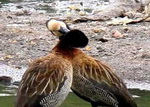
White-faced Whistling-Duck
Dendrocygna viduata
Sirirí pampa/White-faced Whistling-DuckTwo structural characteristics of sievers can be identified in the bill of this White-faced Whistling-Duck. A flared maxilla at the tip and a highly developed nail. Sievers feed separating food particles from the water. The lamellae, thin plates which line the edges of the bill, function like a strainer. They let water out and retain material food.
© José Luis Merlo
Spot-flanked Gallinule
Gallinula melanops
Pollona pintada/Spot-flanked GallinuleCourtship display: The female stimulates the male showing receptiveness. With the back arched, the rigid wings a bit raised as if touching the tips at the back and the head lowered. The male perceives the female´s disposition and follows her.
They engage in a merry-go-round movement and after three turns the female stops to be mounted.
© Roberto Ares
Spot-flanked Gallinule
Gallinula melanops
Pollona pintada/Spot-flanked GallinuleThe female does not dip the head into the water. As the action is finished the female goes away with a wing shuffling. The male makes a bow display arching his body and lowering the head.
© Roberto Ares
Fulvous Whistling-Duck
Dendrocygna bicolor
Sirirí colorado/Fulvous Whistling-DuckUnluckily the scene was captured once it had begun and it was not possible to document the existence of courtship displays prior to mating. During mating the female remains under water and the male holds her by the head. After copulation both celebrate with a short but vigorous water treading as they rise parallel sticking their chests out and keeping their half-folded wings raised.
© Roberto Ares
Rufescent Tiger-Heron
Tigrisoma lineatum
Hocó colorado/Rufescent Tiger-HeronThree chicks in three different sizes. This is because Tiger-Herons, unlike most bird species, begin to incubate immediately after the egg is laid. Since the eggs take the same number of days to develop they hatch staggeredly. This is known as asynchronous hatching and accounts for the difference in size. The oldest chick is almost a month old.
© Claudia y Tito Di Mauro
Red-crested Cardinal
Paroaria coronata
Cardenal común/Red-crested CardinalIn nest
© Claudia y Tito Di Mauro
Red-gartered Coot
Fulica armillata
Gallareta ligas rojas/Red-gartered CootFeeding the chicks
© José Luis Merlo
Gray-breasted Martin
Progne chalybea
Golondrina doméstica/Gray-breasted MartinGray-breasted Martins have arrived …
© Roberto Ares
Gray-breasted Martin
Progne chalybea
Golondrina doméstica/Gray-breasted Martin…and packed the antenna, the meeting place.
© Roberto Ares
Southern Lapwing
Vanellus chilensis
Tero común/Southern LapwingWe did not spot the nest but here is the proof. One of the two chicks, very well camouflaged, under the adult’s supervision.
© Roberto Ares
Rufescent Tiger-Heron
Tigrisoma lineatum
Hocó colorado/Rufescent Tiger-HeronFollowing the development of the heron chicks. They are three weeks old.
© Carlos Gonzalez Ledo
Lake Duck
Nomonyx dominica
Pato fierro/Lake DuckMale
© Roberto Ares
Glittering-bellied Emerald
Chlorostilbon aureoventris
Picaflor común/Glittering-bellied EmeraldMale
© Carlos Gonzalez Ledo
VN:F [1.9.22_1171]
Rating: 7.0/10 (3 votes cast)
VN:F [1.9.22_1171]
Rating: +1 (from 1 vote)
Powered by WordPress Web Design by SRS Solutions © 2013 Reserva Ecológica Costanera Sur Desarrollado por Honou software